On Moral Fiction by John Gardner
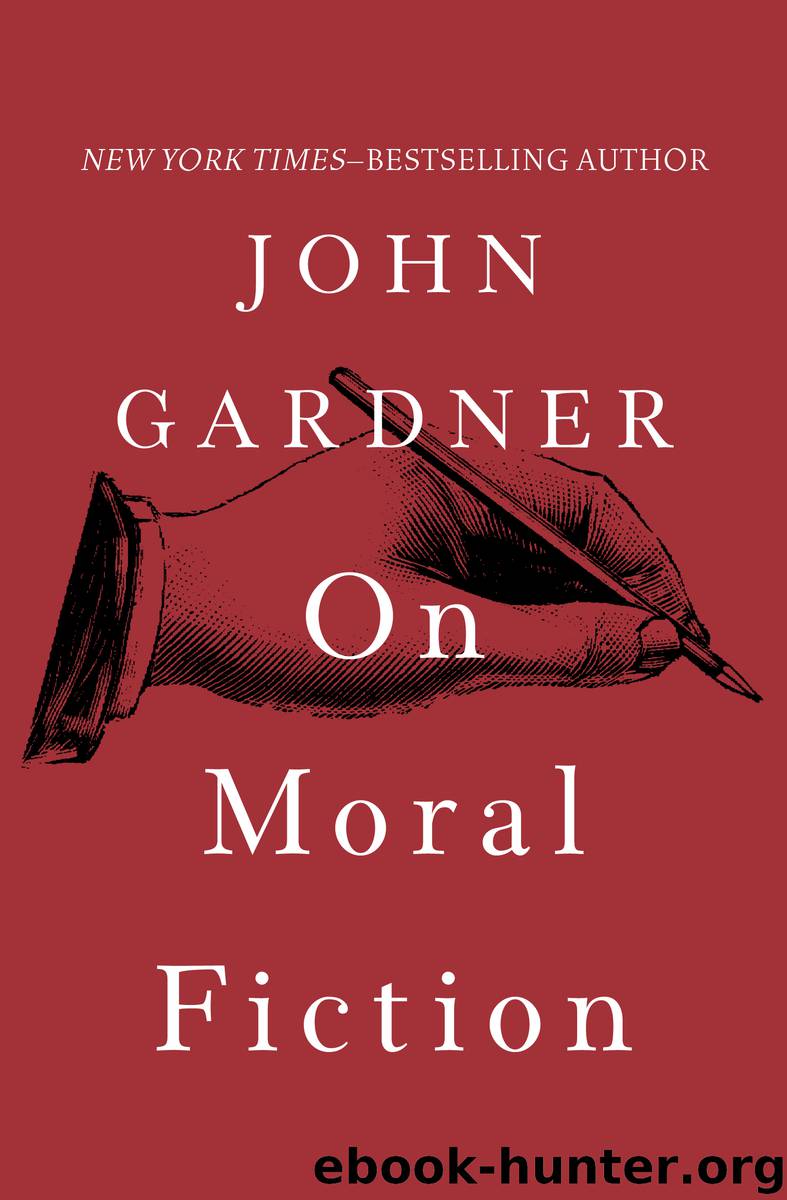
Author:John Gardner [Gardner, John]
Language: eng
Format: epub, azw3
ISBN: 978-1-4804-0921-7
Publisher: Open Road Media
Published: 2013-02-20T22:56:00+00:00
I will mention one last check on fiction’s honesty: tradition. No writer imagines he exists in a literary void. Though writers rarely read as widely as do critics—partly because writers can afford to be critical, throwing out books because of annoying little flaws of conception or execution—it is nevertheless true that writers would not be what they are if they didn’t have a liking for books. A particular writer may read no one but George Gissing or, perhaps, Aristophanes; but he knows full well that one of the things he’s doing when he writes is laboring to achieve an effect at least somewhat similar to effects he has gotten out of other people’s books. When a writer begins a story It was winter of the year 1833. A large man stepped out of a doorway, that writer has a literary tradition in mind, and part of his purpose is to be—besides interesting and original—true to the tradition (or anyway steadily aware of it). When he begins a story She was no longer afraid of the long drive home, he has another distinct tradition in mind, and still another when he begins “Henry, come clean off them boots,” Mrs. Cobb called out the woodshed door. The medium of literary art is not language but language plus the writer’s experience and imagination and, above all, the whole of the literary tradition he knows. Just as the writer comes to discoveries by studying the accidental implications of what he’s said, he comes to discoveries by trying to say what he wants to say without violating the form or combination of forms to which he’s committed. It isn’t true that, as New Critics used to say with great confidence, “Form is content.” The relationship between the two is complex almost beyond description. It is true, as Wallace Stevens said, that “a change of style is a change of subject.”
The process of discovery through a struggle with tradition is most obvious in the retelling of some traditional myth. In my own retelling of the story of Jason and Medea, I shackled myself with one basic rule: I would treat the same events treated in the past (by Apollonius and Euripides), making sure that the characters said approximately the same things, performed the same actions, and made the same friends and enemies among men and gods; but all that happened I would try to understand with a modern sensibility (granting the existence of gods as forces), asking myself how I, in these situations, could say and do what these antique figures did. In what sense could I understand the Sirens, or Circe, or the Golden Fleece? What would make me, as a modern woman (as a writer, one claims androgyny), kill my children? The result of this process is that one gets the impression, rightly or wrongly, that one has to some extent penetrated what is common in human experience throughout time; and since again and again the ancient poets seem right, and “modern sensibility” seems
Download
This site does not store any files on its server. We only index and link to content provided by other sites. Please contact the content providers to delete copyright contents if any and email us, we'll remove relevant links or contents immediately.
4 3 2 1: A Novel by Paul Auster(12382)
The handmaid's tale by Margaret Atwood(7762)
Giovanni's Room by James Baldwin(7334)
Big Magic: Creative Living Beyond Fear by Elizabeth Gilbert(5768)
Asking the Right Questions: A Guide to Critical Thinking by M. Neil Browne & Stuart M. Keeley(5766)
Ego Is the Enemy by Ryan Holiday(5425)
The Body: A Guide for Occupants by Bill Bryson(5088)
On Writing A Memoir of the Craft by Stephen King(4938)
Ken Follett - World without end by Ken Follett(4726)
Adulting by Kelly Williams Brown(4569)
Bluets by Maggie Nelson(4550)
Eat That Frog! by Brian Tracy(4529)
Guilty Pleasures by Laurell K Hamilton(4443)
The Poetry of Pablo Neruda by Pablo Neruda(4100)
Alive: The Story of the Andes Survivors by Piers Paul Read(4026)
White Noise - A Novel by Don DeLillo(4006)
Fingerprints of the Gods by Graham Hancock(4000)
The Book of Joy by Dalai Lama(3981)
The Bookshop by Penelope Fitzgerald(3848)
